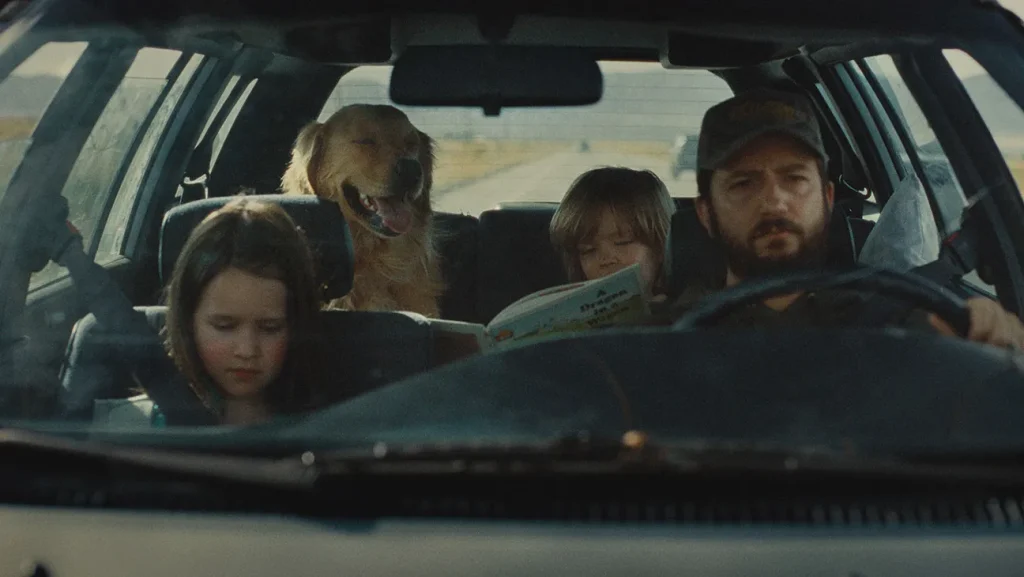
I sat down with Cole Webley, the director of the Sundance-selected drama Omaha, which follows a father who takes his kids on an unexpected road trip to a Nebraska safe haven. Cole self-funded this deeply human first feature at age 40 after two decades shooting commercials around the world, and his passion for exploring the…
I sat down with Cole Webley, the director of the Sundance-selected drama Omaha, which follows a father who takes his kids on an unexpected road trip to a Nebraska safe haven. Cole self-funded this deeply human first feature at age 40 after two decades shooting commercials around the world, and his passion for exploring the complexities of broken parents and the universal trauma of family is palpable in every answer he gives.
McAuley Tucker: You’ve spoken about how you actually had men cry on your shoulder at the screenings at Sundance. This man didn’t speak a lot throughout this film. What is it about his silence that’s breaking them open?
Cole Webley: Well, I think if done best, art is a mirror as a reflection on our own experiences or a vicarious experience… the family dynamic is a source of great peace and joy and also trauma for many people. And the family element here of a father trying to do what’s right by his kids, struggling with that… for better and worse in elements of the story, I feel like it’s just so universal in that we’re all children of somebody. And if you’ve lived with a single parent and you’ve seen them struggle against the machine of trying to raise a family in corporate America and beyond, even with a place in Canada where you have all these social back stops, it’s never easy. And I just think there’s something about John [Magaro’s] performance and the reality and truth of this story that is really hitting men in particular, but also I had many adolescents or kids coming out into adulthood who are realizing they’re coming out of the cocoon of protectiveness of being a child and they’re realizing what their parents offered them and was able to offer them in spite of fiscal or social challenges… I think it’s a testament to what John was able to do in that role with very little words and crack open this idea that fathers and the story about a father struggling and being able to ultimately ask for help, it is kind of a transcendent act.
McAuley Tucker: I believe you did a mission trip in Dominican Republic for two years. I think you were like 19… you were immersed in the poverty, learning Spanish and of course throwing yourself into that world. What did that do to you? How did that change how you see people?
Cole Webley: I think the number one thing that allows you to have a world view and perspective and empathy is generally traveling. When you leave your corner of the neck of the woods and you understand that you’re just a small piece of a much larger mosaic of humanity… it’s impossible, and I think for a lot of people it’s impossible to not feel like how do I fold into this? Who am I and why am I any more significant in this ball in space than these people that I meet? In that case in the Dominican Republic I was 19 to 21 and I lived and walked and talked and became friends with people who lived on dirt floors and corrugated steel, corrugated metal walls and no running water and these were people who saw the world as richly as I did. And it was the fundamental moment in my life where I really started to be curious and want to know more about other cultures, other languages, other people… Travel is a beautiful thing. If you’re lucky enough to get to do it and you listen to it while you’re there, you see that we’re all just part of the same family in a larger, metaphorical way and there’s beauty in that.
McAuley Tucker: The father in Omaha is desperate and you’ve said you see in him a human being. What do you understand about that kind of masculinity that he has and did that come from you at all in any way?
Cole Webley: This is one of those things where I really focused on the text and trusted the text because I came from a home where men were vulnerable, men cried, and they were emotional and they were hard-edged, but they were not afraid to show emotion… So I grew up in the 80s and 90s. Of course I know these men and thankfully my experience as an outsider to some of that baggage that comes with being raised that way allowed me to look at it in a very empathetic and patient way. And ultimately what we wanted to explore was this idea of here’s a very broken man who has nobody to turn to and he literally has to ask a nurse who he doesn’t know from Adam for help because… he’s got maybe too much shame to go to family, which is actually statistically a lot of these kids who were dropped off, there was family who could have taken them but the shame that they carry as parents, they didn’t allow them to drop them with family. They did this instead… I think we’re all better when we allow ourselves to seek and look for help outside of ourselves.
Consider watching Omaha today.