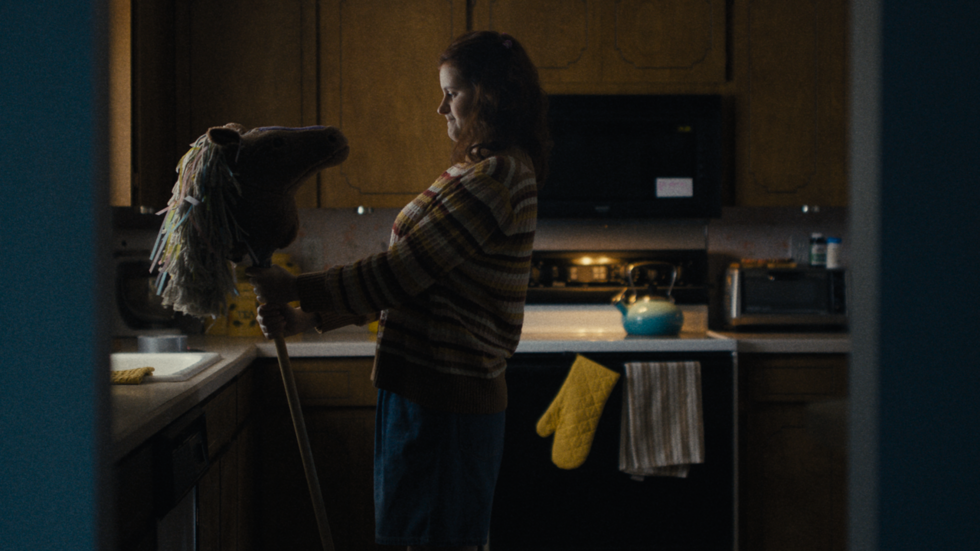
I sat down with writer and director Lauren Meyering and actor Lillian Carrier to talk about Horsegirls, Meyering’s feature debut, which premiered at the 2025 Tribeca Film Festival and opened in select US theaters this July through Sumerian Pictures. Carrier leads the film as Margarita, a 22-year-old autistic woman who finds her footing in competitive hobby horsing while her mother, played by Gretchen Mol, faces an uncertain diagnosis. We opened on something the three of us have in common, which is that we are all twins, and the room loosened from there. What stayed with me is how fast both of them answered questions about what went wrong, and how little either of them wanted credit for fixing it.
McAuley Tucker: Lauren, one thing I thought was really cool about your life is you have some experience working in the music video world, which is somewhat different from the film world. Is there something that producing music videos taught you that film school couldn’t teach you?
Lauren Meyering: Everything. It was a master class in … if you don’t care no one will. And that doesn’t mean that your job ends when the clock hits 4:00, you know, and the energy and the passion, you can’t fake it. You have to care so deeply about what you’re creating. … I’m very big in, like, even all my music videos, they were not performance music videos, they were always narrative stories with actors. … So I think it taught me one, that it is a marathon to get it not only just made but finished and edited and put out there, but also … it taught me whenever there’s a challenge, because you get a lot of nos, you know, when things are just not probable, how to pivot and not go, ‘Oh my gosh, well, it’s ruined.’ … Now when I’m told no, I have this joke that I go, ‘Well, great, because whatever we’re gonna figure out instead is going to be 10 times better than the first thing.’ … I take it as a sign that there’s something better.
McAuley Tucker: Going back over to you, Lillian, from what I understand, correct me if I’m wrong, you worked as a consultant before on … I think a production that you were a part of, you know, and here you’re playing a lead. Was there ever a time in this production where you … put on the consultant hat … to say, hey, I think we should do this, I think we should do this instead.
Lillian Carrier: Yes, a lot. That was something when I booked the role. It was a question I had for the team, of whether or not they wanted my input and expertise that I have, or they just hire me as an actor and I’m just going to perform whatever they put in front of me. And they, yeah, they were very willing and asked for my expertise to be involved. Now, I wasn’t as heavily doing that as I did when it was on Everything’s Going to Be Okay, but yeah, I definitely put in input and put my foot down on things and asked for certain things to be changed. And I’m very grateful for Lauren to be so willing to work with that, but we did hire someone else to do that job for me on set. So … Chloe was the autism sensitivity coordinator and we brought on Alex Plank as the autistic producer to catch most of those things. So I didn’t have to do anything.
McAuley Tucker: Lauren … I found a review of the screenplay back in 2022, which is a long time ago … Someone was reviewing the screenplay and they said it was excellent … And then from the film now, was there anything that changed between the original screenplay and what we see on the screen?
Lauren Meyering: Oh yeah. Oh yeah. It actually ironically was written in 2018. … One of them, like a perfect example, the beautiful scene that I love, … it’s one of my favorite scenes, and where we actually get to go back and forth between Gretchen Mol’s character Sandy and Margarita, is when she’s getting an exam done and she sees her reflection in a painting, and at the same time Margarita is … looking at herself in the mirror and the reflection there. That initial scene was supposed to be an MRI, and we actually learned that, lo and behold, there are only a couple working, you know, like, MRI machines in Oregon. In most states there’s only a couple, and the waiting list is so absurdly long, and it’s like, oh my god, how dare we take that away from someone who needs it. So even then it was just like, okay, immediately pivot, you know. And another huge one was Coach was written to be like a 65-year-old white dude. And I am so beyond grateful that we have the amazing Jerod Haynes playing it … and it was so funny, too, cuz when we had his casting photo in pre-production, so many people were like, ‘That’s not who I pictured Coach as.’ And I went, ‘Me neither.’ And I’m so glad, you know … initially I wrote him to be like kind of like a Santa Claus, you know, and now I cannot fathom it any other way.
McAuley Tucker: Pivoting back again to you, Lillian, this is something I found really interesting about you and your career. … Before you ever were diagnosed, you were watching a show and there was an actor in the show that you said in an old interview that that person is me. And I think that was Michael from Roswell. I was curious if … in this role, if you brought anything from the character Michael that … caught your attention all those years later into your performance, or would you say no, not at all.
Lillian Carrier: I haven’t thought about him in a long time. No, I did not resonate with Michael … I don’t think Margarita and Michael have anything in common. But yeah, I still relate very hard to that character, and that was one that was a strong resonance of, like, how I feel and experience the world. And if I can explain a little bit about that, Michael is an alien in this show, and the relation of autism to alien, when we didn’t have representation, was very much trying to human and not being able to nail those social skills. And especially with Michael, who tried so hard to be a good person, and the world judged him as so evil and bad, and … he was kicked out of school and kicked out of class and got into all these fights, and that was an experience that I had from a very young age. I was labeled a troublemaker instead of someone who … didn’t understand what was going on. And yeah, so I related really strongly with a character like that. And Margarita is just a very, very different experience of that. Like, people don’t understand her, but they misunderstand her in a very different way than that.
McAuley Tucker: I feel like that’s something that a lot of people can relate with, you know, being misunderstood, and I certainly have dealt with a lot of that in my life, and it’s certainly a challenge to deal with.
Consider watching Horsegirls Today.