Last week I got invited to an early press screening of “Spider-Noir,” a room full of critics and reviewers, the first two episodes up on the screen, and a poster I’ve since hung in my room handed to me on the way out. In the days since, I’ve watched the rest of the season, all eight episodes. Here’s the short version before the long one: this is good. Really good. But it is not the show the trailers are selling you, and the sooner you make peace with that, the more you’ll get out of it.
First, the one piece of practical advice that matters more than anything else I’ll say here: watch it in black and white.
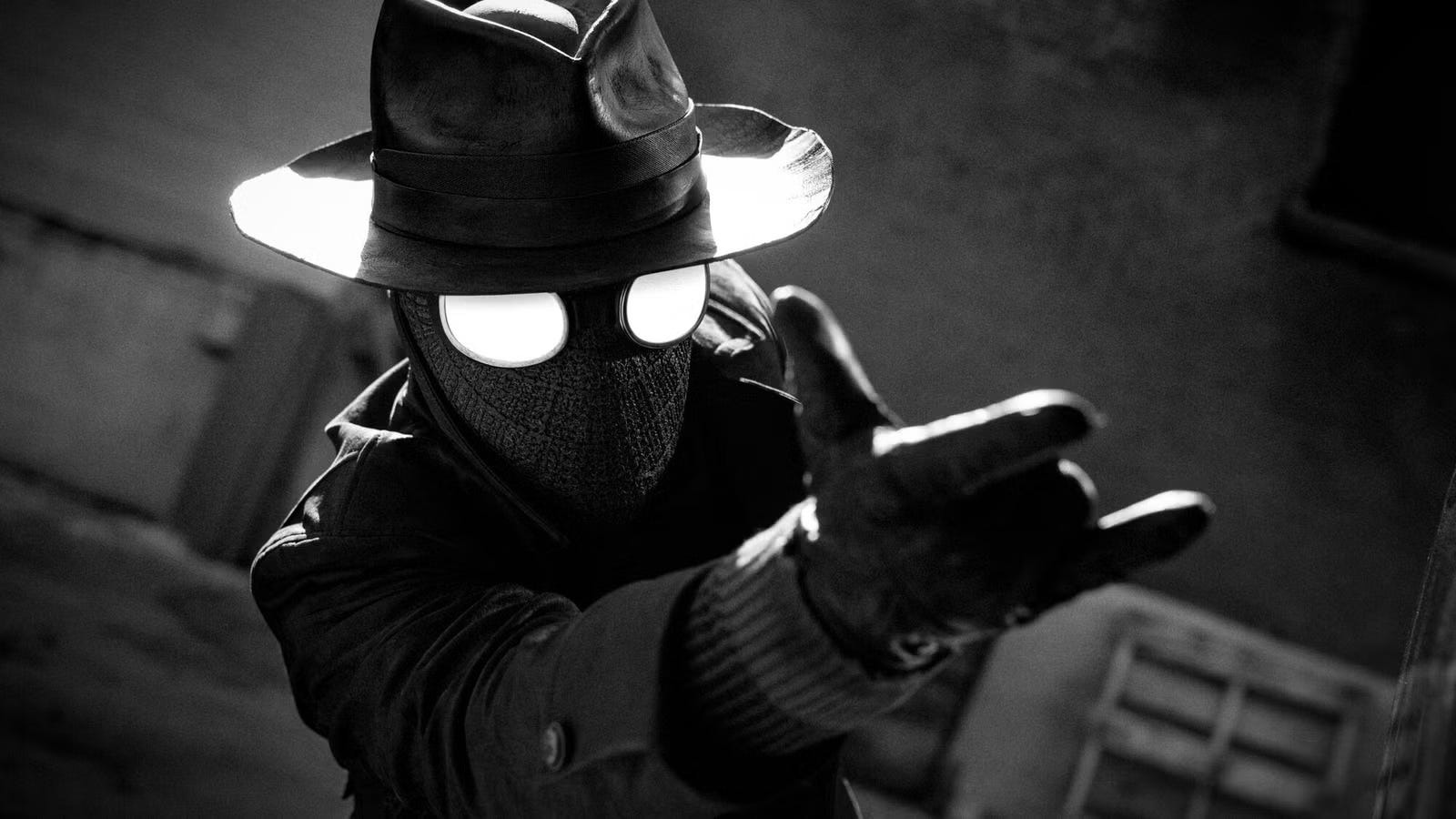
Prime Video is releasing two versions, a full-colour cut and a black-and-white one, and I understand the instinct to reach for colour. It’s bright, it’s slick, it looks great. But “Spider-Noir” is set in 1930s New York, and the black-and-white version does something the colour one can’t. It stops feeling like a modern show wearing a period costume and starts feeling like it actually came out of the era it’s depicting. The shadows get deeper. The contrast carries half the storytelling. There were shots I wanted to pause and put on a wall.
Which brings me to the look of the thing, because visually this is one of the most striking superhero projects I’ve seen in a while. One detail I kept catching: the camera is rarely level. It tilts a few degrees one way, then a few degrees the other, almost never sitting straight. I’m sure there’s a deliberate reason behind it, and whatever it is, it works, because it keeps you slightly off-balance, which is exactly where a noir wants you. Put that together with the shadow work and the period detail and you end up with a show you can freeze on almost any frame.
Then there’s Nicolas Cage. This is his first lead role in a television series, and he is the reason to show up. What I didn’t expect was how funny he is in it. Reilly is quick, dry, always armed with a remark, and the screening I was in laughed out loud more than once at the way he talked back to the people around him. Cage doesn’t play the part as a hero slumming it in a detective story; he plays a worn-out private eye who happens to have a past, and he commits to all of it.
He’s surrounded by people pulling their weight, too. Lamorne Morris, as the journalist Robbie Robertson, steals plenty of scenes. The real surprise for me was a young actor named Cary Christopher, playing an orphan kid who keeps turning up in Reilly’s orbit, essentially a pint-sized version of Cage’s character, same dry wit, and he walks off with every scene he’s in. The back-and-forth between Reilly and his secretary, Janet, is some of the most enjoyable material in the show. Brendan Gleeson’s mob boss and Li Jun Li’s nightclub singer round out a cast with no weak links among the leads.
When the swinging does come, it’s worth the wait. The way it’s shot reminded me of Andrew Garfield’s Spider-Man, with a little of the Sam Raimi and Tobey Maguire sense of movement in the direction of it. Watching a hero move through a 1930s city like that, in black and white, is a genuinely new feeling, as we are so used to seeing this kind of thing in a bright, modern world that the period setting makes it land differently. The music helps, too. There’s a lot of 1930s sound running underneath, and the show leans into it rather than treating it as background.
Now the honest part, because I promised you the long version. If you walk in expecting Spider-Noir in full costume, swinging and fighting for most of the runtime, you are going to be disappointed. You do see Cage in the mask and the suit, but you’re looking at maybe five minutes of suited-up action an episode, and a couple of the eight barely give you that. It’s a deliberate choice. The series catches this character at a low point: he has pulled away from the role, he is struggling with it, so what you get is a lot of depressed Reilly, complaining Reilly, Reilly as a tired investigator rather than Reilly as a wall-crawler. I genuinely liked that version of him. I just kept wanting more of the other one.
I’ll be straight about it: there were stretches where I got a little bored. Some of that is on me, since I watched all eight in a row in a way most people won’t, and some of it was a feeling I couldn’t quite name, something missing, probably just the absence of the costume. The best moments in the whole series are the ones where Reilly finally becomes the Spider and fights, the edge-of-your-seat ones. There just aren’t many of them, and the marketing leans hard on the few that exist. Going in, know that the action is rationed out slowly over the season rather than handed to you up front.
So here is where I land. I’d give the entire viewing experience a 9 out of 10. It’s stunning to look at, it’s genuinely funny, it’s anchored by a Cage performance that more than earns the lead, and it’s held back only by being stingier with the suit than I wanted it to be. Go in for the detective, not for the spider. And watch it in black and white.
“Spider-Noir” releases globally on Prime Video on May 27, in both black-and-white and colour versions.
Consider watching Spider-Noir Today.