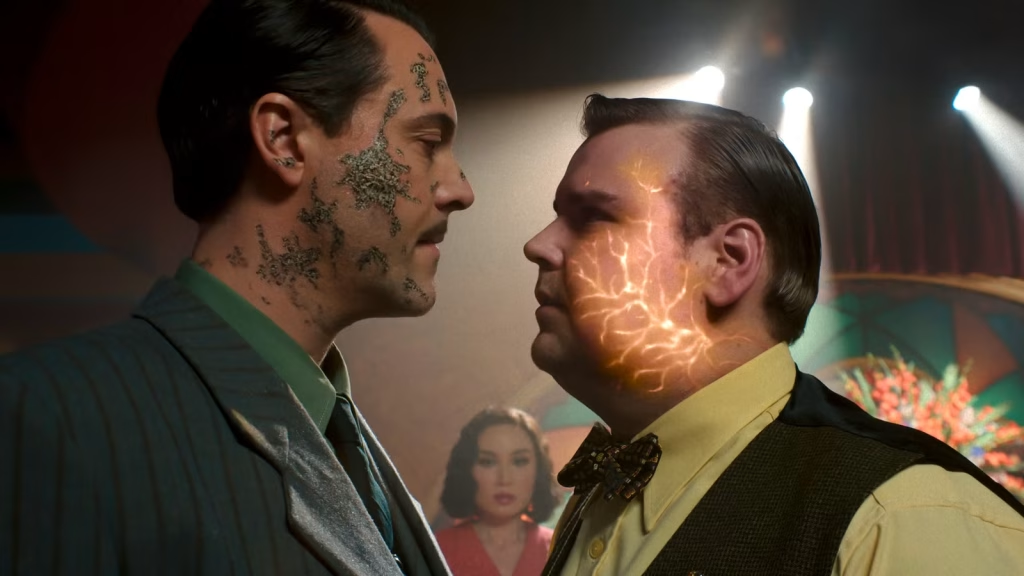
I sat down with actor and acting coach Andrew Lewis Caldwell, who plays the electric, theatrical villain Megawatt in Spider-Noir, the black-and-white 1930s superhero series starring Nicolas Cage. Andrew has spent the better part of two decades in comedy and voice work, from Hannah Montana to College, and now runs his own studio near Buffalo, where he teaches people not how to act, but how to be an actor. What struck me most was how little he wanted to talk about himself: he kept handing the credit to the crew, to his father, to the work, and meant every word of it.
McAuley Tucker: When you were around 18 years old… you were actually part of a whole movie with a bunch of extremely talented people, including John Goodman, and the world never saw it. This never came out… What did that teach you as a kid, that early on, to watch something you make… just disappear?
Andrew Lewis Caldwell: I mean, that happens. It happens in this industry for multiple reasons… I guess the lesson I learned from that film was, you know, making a movie is you become a part of a machine, and your goal is to be the best functioning instrument on that machine. Whether it’s to be an actor, a writer, a director, a PA, a grip, whatever it is, that machine has to run perfectly. And if there are parts of the machine that aren’t functioning properly and aren’t doing it the right way, or aren’t being catered to, the machine falls apart. You have to look after every piece of it, even the small ones… I learned the importance of the crew. I learned the importance of the community that makes the film. It’s also when I learned that the actor is the most insignificant part of the whole thing, and the most replaceable. The actor is just the cover. It’s like we’re the body of the car, but that’s not what makes the car run.
McAuley Tucker: You’re playing a man who’s always performing [in Spider-Noir]. He’s a failed actor doing villain… the minute that you were on screen, I think like five minutes in, I was smiling… How do you play someone who’s constantly acting without it tipping into a cartoon?
Andrew Lewis Caldwell: Yeah, that’s tough. It was tough because, you know, the last thing you want it to do is come off like I’m overacting. I didn’t want it to appear like Andrew was acting like Dirk Leydon. Dirk Leydon is acting like Megawatt, you know, like that was the difference. So it had to start with the layer. Like, it had to start with who is the guy when no one’s looking, so that I can determine how he is when people are looking… I started with the man. I started with Dirk… If you look on the show, there’s this group photo of all the guys getting released from the camp. And if you look in the back, I’m in the photo, and I’m not putting on any sort of performance at all. In fact, I’m very shell shocked, and I’m staring down the barrel of the camera, and that was the moment where I decided that Dirk sees the world as a stage, because this horrible thing had just happened to him and all of his friends, where they were experimented on… that for me was where Dirk Leydon turns to Megawatt, where it’s like, oh, the world wants you to smile and pretend and be nice. Well, I want to watch the world burn. And while I watch it burn, I’m going to smile, and I’m going to do it with a song and a dance… I had these journals that I would keep that ended up turning into very creepy, weird manifestos that I gave to a couple different crew members.
McAuley Tucker: You’ve talked about your father. I believe he was like a cop. He was actually your hero… and you’ve talked about how you almost… followed him into the force because… you wanted to win his approval… Do you feel that, going into Spider-Noir, doing all of this… what do you think about that now?
Andrew Lewis Caldwell: My dad’s the best man, and I love my dad. He was a homicide detective in Flint, Michigan for 30 some odd years. And that career can harden a man… you can only imagine having to see the things that he saw every day. Horrible things. And so it hardened him, and it made him someone that was difficult to get close to. And I think growing up, I wanted that so bad that… my first year on the force would have been his last year, kind of thing. And yeah, but acting happened at a young age, and my dad didn’t get it… I think the validation that I got from my father never really came from what I did for a living. I think it came when I became a father.
McAuley Tucker: I do know one role he probably related to the most was… your first ever role, which was, in fact, you playing a police officer in a play… I wonder if he connected with that one more than any. Did he get a chance to watch you perform on stage?
Andrew Lewis Caldwell: Yeah. So that’s funny… In that play that I did, I played a police officer, and I wore one of my dad’s police officer shirts, his uniform shirts. And my dad ended up moving to Florida once my grandmother got sick, to take care of her, and a couple years back I went back to Michigan, in the house that I grew up in, and I found all my dad’s old police shirts. And one of the police shirts was the shirt that I wore in that play. And I have that shirt now. It’s at my studio… 28 years later, I still have the shirt, and that’s pretty cool.
McAuley Tucker: Your career is very nuanced, and I hope that we were able to cover some of the nuances in our conversation.
Consider watching Spider-Noir Today.