I went into “A Prayer for the Dying” expecting something lighter. The trailer is cut so well that I’d seen a comment calling it a fun film for the family as a joke, and John C. Reilly’s name on the poster didn’t argue the point. This is the voice of Wreck-It Ralph, after all, and the guy from “Step Brothers.” So let me say it plainly for any parent reading: this is not a family movie. It’s a slow, sad and often striking frontier drama, and it’s the first feature from writer and director Dara Van Dusen.
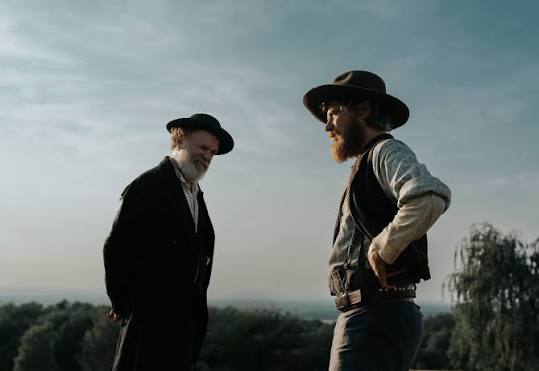
The film adapts Stewart O’Nan’s 1999 novel. It’s 1870 in Friendship, Wis., a small town of Scandinavian settlers still carrying the weight of the Civil War. Johnny Flynn, who played Mr. Knightley in “Emma” and Dickie Greenleaf in Netflix’s “Ripley,” is Jacob Hansen, a veteran who serves as the town’s sheriff, pastor and undertaker at once. Reilly plays Doc, the town physician, and Kristine Kujath Thorp plays Jacob’s wife, Marta. When diphtheria starts killing people and a wildfire creeps toward town, Jacob has to decide who he’s really protecting: his own family or everyone else.
The camera is the star, and it will split people
The cinematography by Kate McCullough is a 10 out of 10 for me. It’s also going to be the most argued-about thing in the film, because it isn’t normal. The camera snaps sideways, turns away from people in the middle of a scene and swings back. Someone compared the look to Wes Anderson, and I can see a little of that in the framing, but the feeling is completely different.
When I interviewed Van Dusen, she told me the camera was designed to represent faith, God or nature, a real character that is deliberately not human. “It only moves straight and at right angles,” she said. Once you know that, the strange movement starts to read like something larger watching this town. For me, that’s where the suspense comes from. A camera that can’t settle won’t let you settle either, and in a story where any cough could be the beginning of the end, that restlessness does real work.
A slow burn that trusts its silences
This is a slow film. You don’t get everything up front, and you need to sit through the whole thing to understand what it’s building. I always say a film needs a strong beginning, middle and end, and honestly, the middle here is the roughest stretch. Some films let the ending reframe everything before it, though, and this is one of them.
O’Nan’s novel is very dark, and I’m not usually a fan of films that live in darkness. This one never felt cruel to me. It’s bleak and it’s sad, but what you’re really watching is a world slowly collapsing, and I think Van Dusen captures that well. I love films that are willing to pause, go quiet and let you sit with a moment, and this one does that often.
The acting holds it together. I was rooting for Flynn’s Jacob the whole way, even as his choices got harder. Even the children are great, which is rarer than it should be.
That ending
No spoilers here. When the ending began, I said “what?” out loud. It confused me a little at first, and I wrestled with it for a while (maybe I’m slow), but it’s the part that has stayed with me. I was never bored, because I genuinely needed to know how this would end. It’s the kind of film you finish and then sit with, and I’d like to watch it again with friends just to talk it through.
The verdict
“A Prayer for the Dying” is not a blockbuster, and it isn’t for everybody. Some people will give it heat for the camera and the pace. It’s almost there. It needs a couple of things, mainly a tighter middle, but it’s a thoughtful, experiential film with a wonderful cast and a wonderful cinematographer, and I’m thankful a first-time director swung this big.
My score: 3.5 out of 5. Watch it on a night when you have time to think about it afterward.
“A Prayer for the Dying” opened in select North American theatres on Oct. 9 through Quiver Distribution. It runs 95 minutes and is not rated. My full conversation with Van Dusen is coming soon on The McAuley Tucker Show.