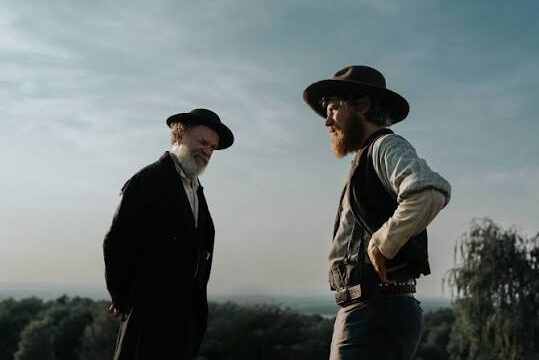
I sat down with writer-director Dara Van Dusen for an exclusive press junket on her feature debut, “A Prayer for the Dying,” a post-Civil War drama adapted from Stewart O’Nan’s 1999 novel and starring Johnny Flynn and John C. Reilly. Van Dusen is a born-and-raised New Yorker who studied at the Polish National Film School in Łódź and spent 10 years working in Norway, and she finally shot this 1870s Wisconsin story in Slovakia as a six-country co-production, 17 years after she first set out to make it. What stuck with me most was how quickly she gave the credit away, to a room of Polish actors who didn’t speak her language and to her best friend and cinematographer, Kate McCullough, and I definitely didn’t expect her to turn one of my questions right back around on me.
McAuley Tucker: I believe for your… entrance exam, they put you in a room with a bunch of Polish actors who didn’t speak English, and they gave you like 20 minutes, I believe, you can correct me if I’m wrong, to rehearse a scene with them. In that moment there, you know, what did that teach you about directing that you still use today? In fact, maybe even used in this production.
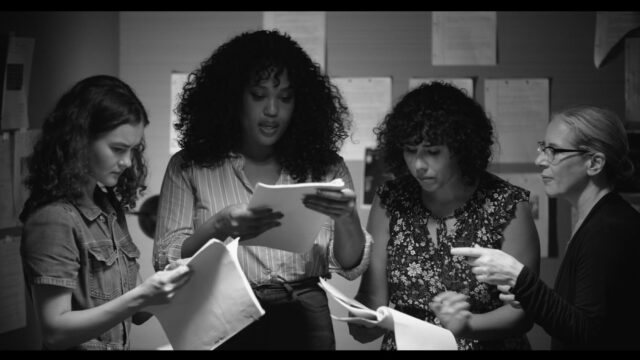
Dara Van Dusen: That’s a fantastic question, and that is this kind of turning point in my life. I was 17 years old and I was in Poland, and I didn’t quite understand what was going on, and they put you in this room and you have all these theatre actors and… you have to pick out of a hat a theme, and I picked out ‘it’s a bomb.’ That was what I picked out. And then I turned around and started speaking to these actors, and I’m 17. I don’t even know what directing is. I’m just talking, trying to come up with a story, and then I realized none of them speak English. And I’m like, ‘Oh my god.’ And I started to realize that also directing is allowing other people to work, because… the world is full of talented people and you’re just kind of guiding them into position. And also, so much of acting and emotional expression is the way in which a body moves through space… It’s not always the word… It wasn’t just me and the 20 actors. You have a commission of professors watching you do the entire thing while chain smoking in this theatre… But I learned so much from that, and somehow a scene came together, and somehow I got into the directing program. So it seemed to have gone somewhat well… The actors coming together with a birthday party, and there was a gift, and somebody starts to think it’s a bomb. You know, we came up with it together because I had to trust them. I think it teaches you that as a director, you trust and step back sometimes. Not always, but sometimes.
McAuley Tucker: One thing that many people… might not know about this is that in this production, you guys talked about kind of the camera being called, I think, the faith camera. It’s like… the way of shooting feels as if it’s the god these characters believe in is watching them. I thought that was super cool… After living with these characters so long, did it change anything about how you think about the subject of faith?
Dara Van Dusen: I was raised in a household that was quite atheist, which in and of itself is almost religious, right? Because atheists have rules and things they believe in. But then naturally, you know, my rebellion then is like, ooh, I’m fascinated by religion… And when I read the book, I had this real moment of wondering if there’s a value that religion can have in society in certain ways that maybe we’re dismissing too easily in current time. Not to say that we need it or that any specific religion is the one, but that there is value there that we’ve kind of, you know, thrown out the window and not really thought about. And as I age, I think about that more and more and more, because, you know, less and less people do believe in a higher power… Because then suddenly we don’t have this kind of moral code to follow. So what moral code are you following? And I think it’s great if you follow your own. But I also think humans are complicated and flawed, and our moral code sometimes needs a little help. So where are you going to get that guidance? Now I think that’s worth thinking about. I’m not saying go and be religious, but I think it’s not something that should be dismissed and laughed at in the way that I think many of us, myself included, have done in recent years. And I’m so happy you bring up the faith camera, because Kate and I… went to the Polish film school together as foreigners… She was in cinematography, and we were just by chance roommates, and we woke up talking to each other in our sleep the first night we met in the dormitory. She’s my best friend, the godmother to my daughter. She’s just a huge part of my life. And we had so much trust within one another… trust is everything, especially if you want to push the limits a little bit. You have to trust each other and be willing to make fun of yourself and look like an idiot in order to find the real interesting things. And so we built this camera that we wanted to represent faith, God, nature, whatever it is you think, and have it be a real character, but it was so important that it wasn’t a human character. So we could develop these movements that were so inhuman. It only moves straight and at right angles and in all the wrong ways that you think of in film. It’s not natural. It is other.
McAuley Tucker: You said that, you know, when you were showing one of your student films to your professors, they… sat you like in a big red chair and shouted at you… They didn’t like anything that was stylized. And the first thing one of them asked you was, ‘Do you really deserve to be here?’ And then this year… you were looking through a book of old photographs… from small town Wisconsin that actually inspired this story. And you said the pictures were framed a little bit wrong, but there was a confidence in its incorrectness. Is that what you’ve been defending this entire time in your… creative journey, that there’s a confidence in the incorrectness?
Dara Van Dusen: Yes. I mean, I want to steal that sentence from you and wrap it around me and use it everywhere I go now… I’ve learned to have a confidence in the incorrectness… When you make anything and you release it into the world, it’s a hugely confrontational experience for you as a person… I love a film that creates reactions and split reactions. That’s exciting… I want everybody to love me. I want everybody to kiss my feet and tell me I’m a genius. I’m a human. And when I showed the film and we had over-the-top praise, but also really negative critiques… personally, I felt a lot of things, and I didn’t understand what was happening… But then I had this moment with Kate when it was happening, because I felt so shocked by the reactions, and I couldn’t quite process… it was really overwhelming, and she said, you know, this has always happened. This happened in the Polish film school. Everything you made, it was just huge reactions, and that’s a school that kicks students out every year based on their films. So they were like, truly, like, ‘You shouldn’t be here.’ But two people thought it was fantastic… As I age, I think leaning into embracing the… incorrectness, there’s something beautiful in it, because things that are just a little bit off create a feeling in the audience member, and that’s really interesting to play with.
McAuley Tucker: Final question. You know, looking back in the room in Poland, if you could sit down next to the 22-year-old in that velvet chair… What was she right about all along?
Dara Van Dusen: That’s such a good question that you’re my therapist now. She was right about trusting her gut and her instinct, and that that’s always the correct thing to do, for better or for worse. There is such a thing as a noble failure, and I would so much rather make that than something that just feels like it’s not my own. So to keep going. And I would also tell her this is the hardest profession in the world, and it is not going to get any easier. So you better buckle up and just get ready for the ride.
Consider watching A Prayer for the Dying Today.